Urban Air Mobility
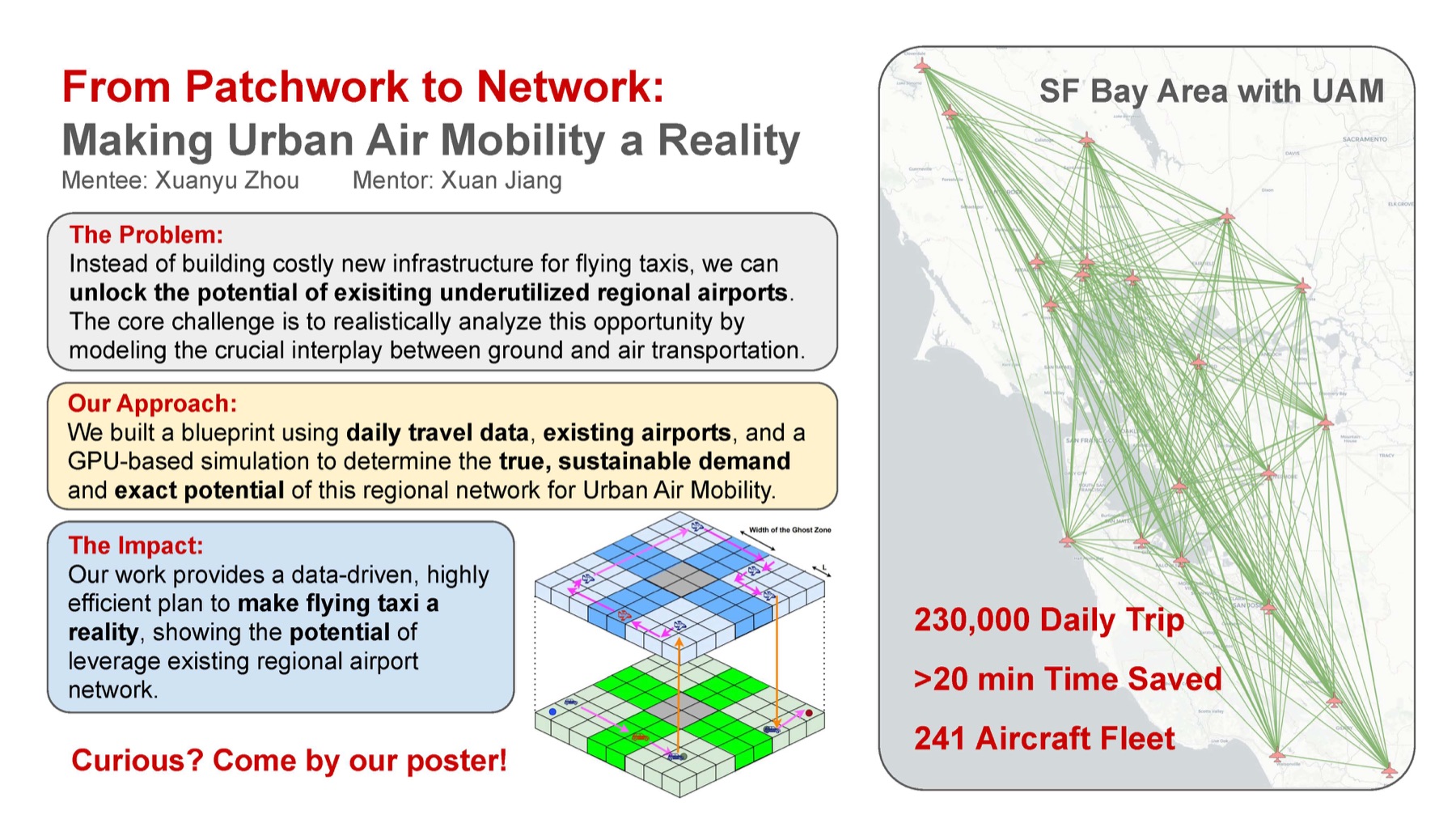
Could commuter flights from the Bay Area’s existing regional airports take real pressure off its congested roads? Urban Air Mobility (UAM) is usually discussed as a distant vision because new infrastructure is expensive and operations are complex. We sidestep part of that problem by modeling a UAM network that reuses regional airports already in place, served by a mixed fleet of aircraft.
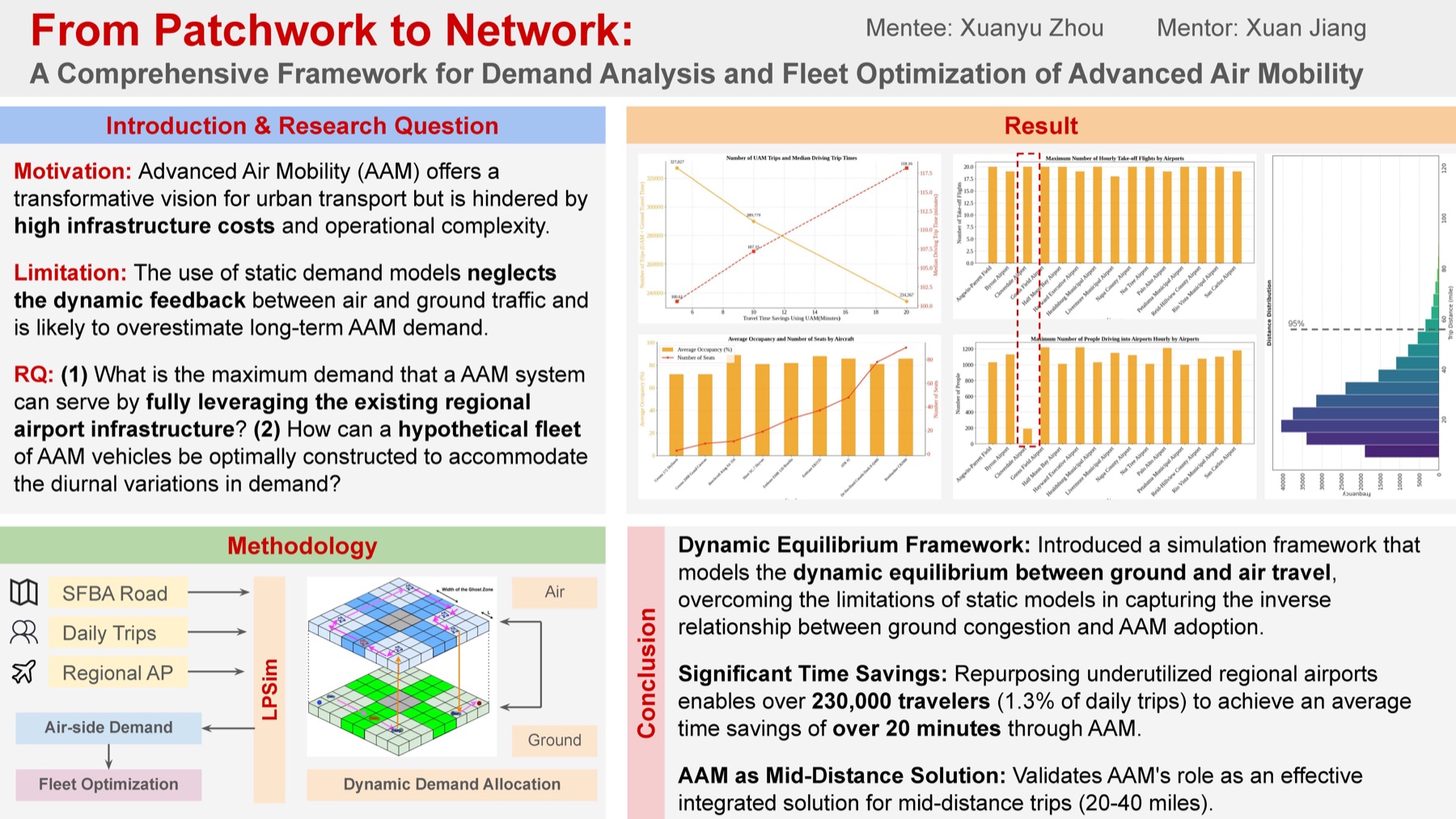
The study builds on LPSim, a large-scale parallel simulation framework that uses multi-GPU computing to co-optimize UAM demand, fleet operations, and interactions with ground transportation. We extended its equilibrium search algorithm to forecast demand and find the most efficient fleet composition. In the San Francisco Bay Area case study, the network saves over 20 minutes of travel time for 230,000 selected trips. The same analysis shows the catch: those savings depend on smooth ground access and dynamic scheduling, not on the aircraft alone.
This work started at the 2025 MIT-UF-NEU joint summer research program, was presented at the 2026 Transportation Research Board Annual Meeting, and is under review at IEEE Transactions on Intelligent Transportation Systems.
Preprint paper can be found here.